

 Human souls are well-acquainted with this perceptible and known world; nothing weighs heavily upon them except that which is entirely new or extraordinary. Yet, despite this, man continuously remains in pursuit of researching and seeking out those things which are hidden and concealed within this universe. He possesses an innate passion and yearning to trace things that are absent from vision and to become aware of hidden secrets and mysteries. The world of Jinnat is also among those realities regarding which a keen interest resides in the hearts to comprehend. To understand the states of Jinnat, man remains on the lookout for those literary works of the Ahl-e-Ilm (scholars) in which this subject has been written upon. Observing this very passion of the public, certain Ahl-e-Ilm have authored independent books on this subject, wherein the conditions of Jinnat are discussed in detail, and Read more [...]
 Research on Jinnat
Human souls are well-acquainted with this perceptible and known world; nothing weighs heavily upon them except that which is entirely new or extraordinary. Yet, despite this, man continuously remains in pursuit of researching and seeking out those things which are hidden and concealed within this universe. He possesses an innate passion and yearning to trace things that are absent from vision and to become aware of hidden secrets and mysteries. The world of Jinnat is also among those realities regarding which a keen interest resides in the hearts to comprehend. To understand the states of Jinnat, man remains on the lookout for those literary works of the Ahl-e-Ilm (scholars) in which this subject has been written upon. Observing this very passion of the public, certain Ahl-e-Ilm have authored independent books on this subject, wherein the conditions of Jinnat are discussed in detail, and Read more [...]  Amaliyaat has a deep and specific affinity with Dua (supplication) and Munajat (whispered prayers). The purpose of reciting Ayat, performing the Wird of Asma-e-Ilahi (Divine Names), or writing them and creating their Naqsh is to benefit from their blessings (Barakat) and spiritual grace (Faiz), just as we draw benefit from Faiz in Dua or Munajat.
Allah Ta'ala has declared: "ما خلقت ھذا باطل" ("You have not created all this in vain").
From this, it is absolutely clear that Allah has embedded both Faida (benefit) and Nuqsan (harm) within everything. However, whether a thing delivers benefit or harm depends entirely upon the Will of Allah. Whichever task Allah wishes to extract from a thing, it functions exactly in that manner. The actions of Zahr (poison) and Taryaq (antidote) operate strictly according to the Will and Masheeat (Divine Intent) of Allah. The function of Zahr is
Amaliyaat has a deep and specific affinity with Dua (supplication) and Munajat (whispered prayers). The purpose of reciting Ayat, performing the Wird of Asma-e-Ilahi (Divine Names), or writing them and creating their Naqsh is to benefit from their blessings (Barakat) and spiritual grace (Faiz), just as we draw benefit from Faiz in Dua or Munajat.
Allah Ta'ala has declared: "ما خلقت ھذا باطل" ("You have not created all this in vain").
From this, it is absolutely clear that Allah has embedded both Faida (benefit) and Nuqsan (harm) within everything. However, whether a thing delivers benefit or harm depends entirely upon the Will of Allah. Whichever task Allah wishes to extract from a thing, it functions exactly in that manner. The actions of Zahr (poison) and Taryaq (antidote) operate strictly according to the Will and Masheeat (Divine Intent) of Allah. The function of Zahr is  Allah Tabarak-wa-Ta'ala declares:
الَّذِیْنَ اِذَاۤ اَصَابَتْهُمْ مُّصِیْبَةٌۙ-قَالُوْۤا اِنَّا لِلّٰهِ وَ اِنَّاۤ اِلَیْهِ رٰجِعُوْنَ
(Surah Al-Baqarah: 156)
Translation: Those who, when a misfortune befalls them, say: "Indeed, we belong to Allah and indeed to Him we are returning."
The etiquette and methods for reciting this Ayat-e-Mubaraka have been established by the Sufiya-e-Kiram and Auliya-e-Izam, from which millions of human beings have benefited. If you are afflicted by any distress or calamity, bring the method detailed below into practice, placing full reliance upon Allah with complete sincerity of heart and intention. Insha-Allah Ta'ala, the problem will be resolved.
Observe a Roza (fast) on a Thursday during Urooj-e-Mah (the waxing phase of the moon). The period up to the 13th night
Allah Tabarak-wa-Ta'ala declares:
الَّذِیْنَ اِذَاۤ اَصَابَتْهُمْ مُّصِیْبَةٌۙ-قَالُوْۤا اِنَّا لِلّٰهِ وَ اِنَّاۤ اِلَیْهِ رٰجِعُوْنَ
(Surah Al-Baqarah: 156)
Translation: Those who, when a misfortune befalls them, say: "Indeed, we belong to Allah and indeed to Him we are returning."
The etiquette and methods for reciting this Ayat-e-Mubaraka have been established by the Sufiya-e-Kiram and Auliya-e-Izam, from which millions of human beings have benefited. If you are afflicted by any distress or calamity, bring the method detailed below into practice, placing full reliance upon Allah with complete sincerity of heart and intention. Insha-Allah Ta'ala, the problem will be resolved.
Observe a Roza (fast) on a Thursday during Urooj-e-Mah (the waxing phase of the moon). The period up to the 13th night  سَبَّحَ لِلّٰہِ مَا فِی السَّمٰوٰتِ وَ الۡاَرۡضِ ۚ وَ ہُوَ الۡعَزِیۡزُ الۡحَکِیۡمُ
“Whatever is in the heavens and the earth glorifies Allah, and He is the All-Mighty, the All-Wise.”
وَ سَخَّرَ لَکُمۡ مَّا فِی السَّمٰوٰتِ وَ مَا فِی الۡاَرۡضِ جَمِیۡعًا مِّنۡہُ ؕ اِنَّ فِیۡ ذٰلِکَ لَاٰیٰتٍ لِّقَوۡمٍ یَّتَفَکَّرُوۡنَ
And He has subjected (through His designed laws of nature) for you whatever is in the heavens and whatever is on the earth—all is from Him. There are indeed signs in that for people who reflect.
The Planetary Talismans
It is written in the book Sham‘-e-Shabistān-e-Razā that during the era of Alexander the Great (Dhul-Qarnayn), the tribe of Gog and Magog caused extreme
سَبَّحَ لِلّٰہِ مَا فِی السَّمٰوٰتِ وَ الۡاَرۡضِ ۚ وَ ہُوَ الۡعَزِیۡزُ الۡحَکِیۡمُ
“Whatever is in the heavens and the earth glorifies Allah, and He is the All-Mighty, the All-Wise.”
وَ سَخَّرَ لَکُمۡ مَّا فِی السَّمٰوٰتِ وَ مَا فِی الۡاَرۡضِ جَمِیۡعًا مِّنۡہُ ؕ اِنَّ فِیۡ ذٰلِکَ لَاٰیٰتٍ لِّقَوۡمٍ یَّتَفَکَّرُوۡنَ
And He has subjected (through His designed laws of nature) for you whatever is in the heavens and whatever is on the earth—all is from Him. There are indeed signs in that for people who reflect.
The Planetary Talismans
It is written in the book Sham‘-e-Shabistān-e-Razā that during the era of Alexander the Great (Dhul-Qarnayn), the tribe of Gog and Magog caused extreme 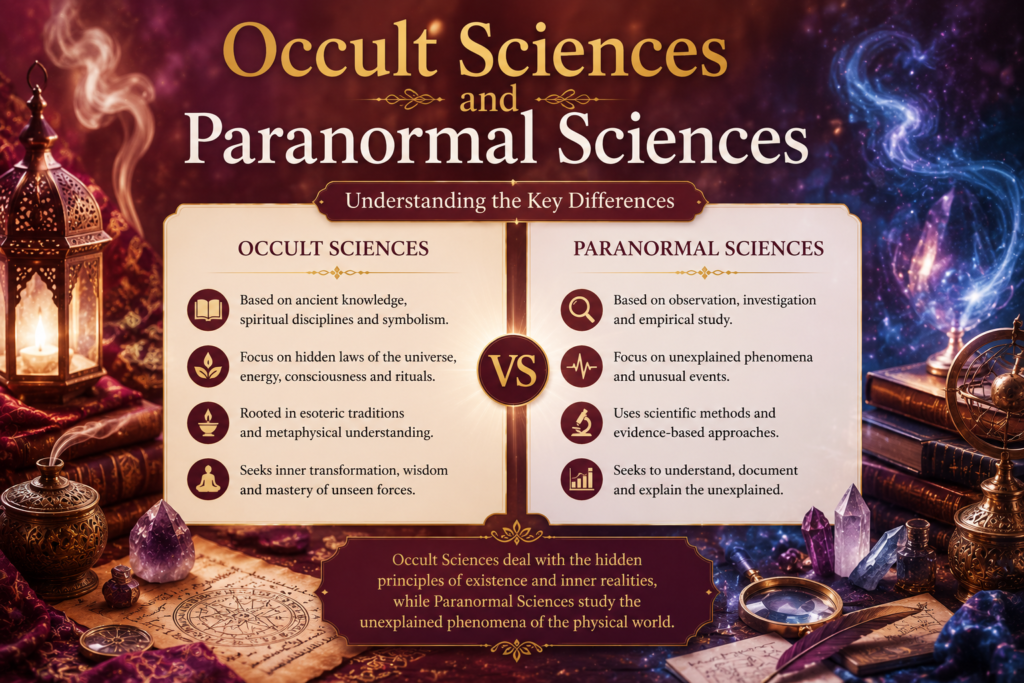 It should be clarified that hidden sciences are known as Occult Sciences, and transcendent/supernatural sciences are commonly referred to as Paranormal Sciences.
Within Uloom-e-Makhfiya (Occult Sciences), all those branches of knowledge are included which we recognize as Ilm al-Haroof (science of letters), Ilm al-Jafr, Ilm al-A‘daad (numerology), Ilm-e-Raml (geomancy), Ilm al-Naqsh (talismanic structures/squares), and other similar sciences.
On the other hand, within Maworai Uloom (transcendent sciences), all those sciences are encompassed in which the core focus is directed toward the acquisition of spiritual powers. Examples include Ashghal-o-Muraqabat (spiritual exercises and meditations), Amal-e-Tanaffus (breathwork), Chilla Kashi (spiritual seclusion/retreats), paying the Zakat of A'maal (spiritual operations), and awakening healing and spiritual capacities—which involves Yoga
It should be clarified that hidden sciences are known as Occult Sciences, and transcendent/supernatural sciences are commonly referred to as Paranormal Sciences.
Within Uloom-e-Makhfiya (Occult Sciences), all those branches of knowledge are included which we recognize as Ilm al-Haroof (science of letters), Ilm al-Jafr, Ilm al-A‘daad (numerology), Ilm-e-Raml (geomancy), Ilm al-Naqsh (talismanic structures/squares), and other similar sciences.
On the other hand, within Maworai Uloom (transcendent sciences), all those sciences are encompassed in which the core focus is directed toward the acquisition of spiritual powers. Examples include Ashghal-o-Muraqabat (spiritual exercises and meditations), Amal-e-Tanaffus (breathwork), Chilla Kashi (spiritual seclusion/retreats), paying the Zakat of A'maal (spiritual operations), and awakening healing and spiritual capacities—which involves Yoga  Every flower possesses a distinct color and fragrance. The therapeutic effect resides within both the color and the scent. Apart from awakening delicate and pure emotions such as love and affection, fragrance also actively influences various organs of the body.
Every creation of nature upon this earth possesses some form of color and odor. The mere mention of the word fragrance (Khushboo) evokes a sense of freshness. Fragrance removes the heaviness of disposition, generating freshness and exhilaration within the temperament. While it dispels mental fatigue, it also alleviates the distresses brought on by changing weather. Muslim scientists prepared essences (Atr) from countless fragrant flowers, which were utilized according to the season. Within our historical culture, specific Atr were designated for summers, winters, the rainy season, and spring. Their application within the science of
Every flower possesses a distinct color and fragrance. The therapeutic effect resides within both the color and the scent. Apart from awakening delicate and pure emotions such as love and affection, fragrance also actively influences various organs of the body.
Every creation of nature upon this earth possesses some form of color and odor. The mere mention of the word fragrance (Khushboo) evokes a sense of freshness. Fragrance removes the heaviness of disposition, generating freshness and exhilaration within the temperament. While it dispels mental fatigue, it also alleviates the distresses brought on by changing weather. Muslim scientists prepared essences (Atr) from countless fragrant flowers, which were utilized according to the season. Within our historical culture, specific Atr were designated for summers, winters, the rainy season, and spring. Their application within the science of  In the Arabic language, where the word Rizq conveys the meaning of daily bread and sustenance, it is also used to denote all forms of divine bounties. Accordingly, within the Holy Quran, it has been utilized for wealth and assets, for the provisions of life, and has also been used for guidance and spiritual gnosis (Hidayat-o-Ma'rifat). Briefly, we can state that the word Rizq is used for every single bounty bestowed upon the servants by Allah Almighty. Allah Almighty has commanded mankind in general, and Muslims in particular, to distinguish between Rizq-e-Halal (lawful sustenance) and Rizq-e-Haram (unlawful sustenance); earning a Halal livelihood and abstaining from Haram is just as essential as practicing Namaz, Roza (fasting), and other foundational obligations (Faraiz)... Yet, it is astonishing that even within Muslim societies, few people distinguish between Halal and Haram. Indeed,