
The details written by authentic Aamilheen and Kamileen in books regarding the avoidance of animal products (Tark-e-Haywanat) for the purpose of Chilla Kashi are as follows:
There are two types of Tark-e-Haywanat:
Jamali
Jalali
In Tark-e-Haywanat-e-Jamali, the items intended to be avoided include every type of meat, egg, fish, vinegar, raw or cooked onion, garlic, Jimaa (marital intimacy), and refraining from Nazar-e-Bad (the evil eye), etc.
In Tark-e-Haywanat-e-Jalali, one must refrain from every type of meat, egg, fish, vinegar, raw or cooked onion, garlic, honey, Mushk (musk), every type of Kushta (calx), and any grain grown using fertilizer. It also includes refraining from Jimaa and Nazar-e-Bad; food must not be eaten if cooked in a metal utensil, nor should a metal spoon be dipped into it. The cooking pot (Handi) must be made of clay, the ladle (Doi) must be made
Read more [...]


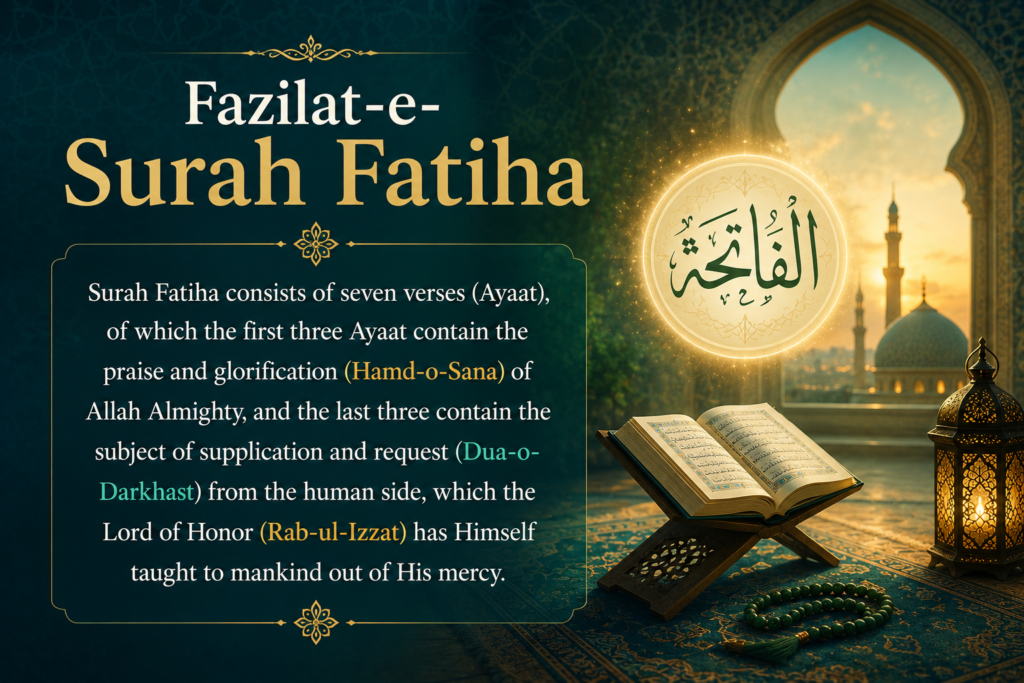 The companion of the Prophet (Sahabi-e-Rasool), Hazrat Abu Zaid رضی اللہ عنہ narrates: "Once it was night time, and I was walking with the Beloved Master, the Makki Madani Mustafa صلى اللہ علیہ و آلہ و سلم through a street of Madinah Munawwarah. Suddenly, a voice came from a house; a Sahabi رضی اللہ عنہ was reciting Surah Fatiha in the Tahajjud prayer. Hearing this, the Messenger of Allah, the embodiment of light (Noor-e-Mujassam) صلى اللہ علیہ و آلہ و سلم stopped and began listening to the recitation of Surah Fatiha. When the Sahabi رضی اللہ عنہ completed the recitation of Surah Fatiha, the Last Prophet of Allah, the Hashimi Messenger صلى اللہ علیہ و آلہ و سلم remarked: 'مَا فِی الْقُرْآنِ مِثْلُہَا' — meaning, there is no Surah like it in the Holy Quran."
Numerous virtues (Fazail) Read more [...]
The companion of the Prophet (Sahabi-e-Rasool), Hazrat Abu Zaid رضی اللہ عنہ narrates: "Once it was night time, and I was walking with the Beloved Master, the Makki Madani Mustafa صلى اللہ علیہ و آلہ و سلم through a street of Madinah Munawwarah. Suddenly, a voice came from a house; a Sahabi رضی اللہ عنہ was reciting Surah Fatiha in the Tahajjud prayer. Hearing this, the Messenger of Allah, the embodiment of light (Noor-e-Mujassam) صلى اللہ علیہ و آلہ و سلم stopped and began listening to the recitation of Surah Fatiha. When the Sahabi رضی اللہ عنہ completed the recitation of Surah Fatiha, the Last Prophet of Allah, the Hashimi Messenger صلى اللہ علیہ و آلہ و سلم remarked: 'مَا فِی الْقُرْآنِ مِثْلُہَا' — meaning, there is no Surah like it in the Holy Quran."
Numerous virtues (Fazail) Read more [...] 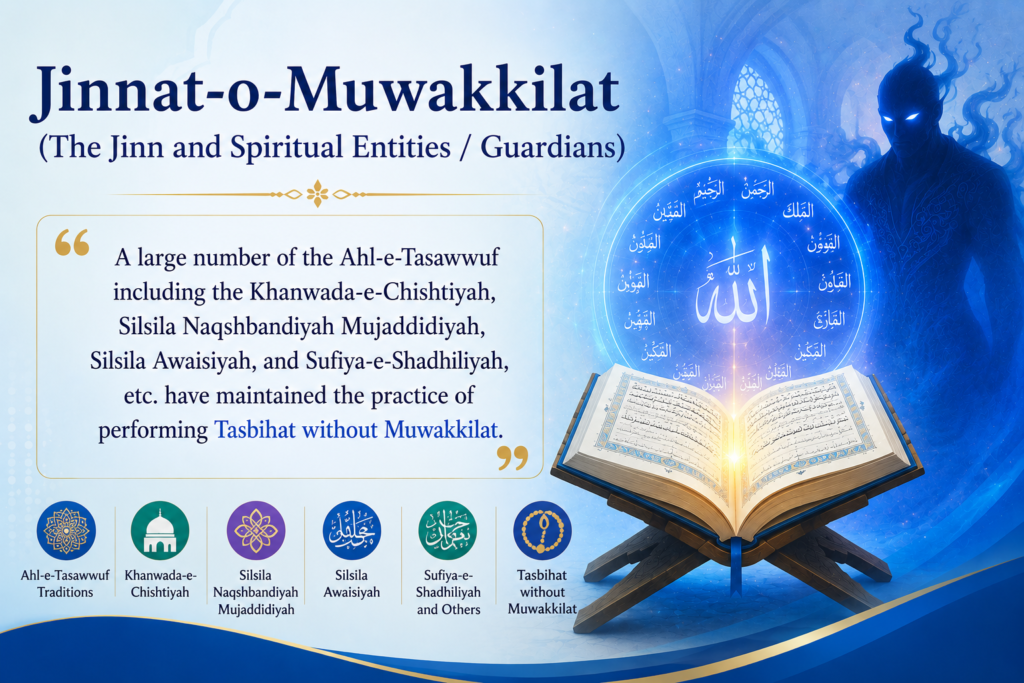 A large number of the Ahl-e-Tasawwuf including the Khanwada-e-Chishtiyah, Silsila Naqshbandiyah Mujaddidiyah, Silsila Awaisiyah, and Sufiya-e-Shadhiliyah, etc. have maintained the practice of performing Tasbihat without Muwakkilat. If the objective is the Tasbih or Chilla of Asma al-Husna, Quranic verses (Ayaat) and Surahs, Darood Shareef, or other Masnoon Azkar, they give preference solely to Tasbihat without Muwakkil. This is done so that by raising one's spiritual capacity through praiseworthy qualities (Ausaaf-e-Hameeda), the subtleties of the heart (Lataif-e-Qalbi), and the tranquil self (Nafs-e-Mutmainnah), a station is reached where special bounty, grace, and divine lights (Anwaar) are attained, and the Muwakkilat and other creations willingly become ready to assist on their own. In this manner of practice, at the time of observing or encountering the Muwakkilat, the heart (Qalb) remains
 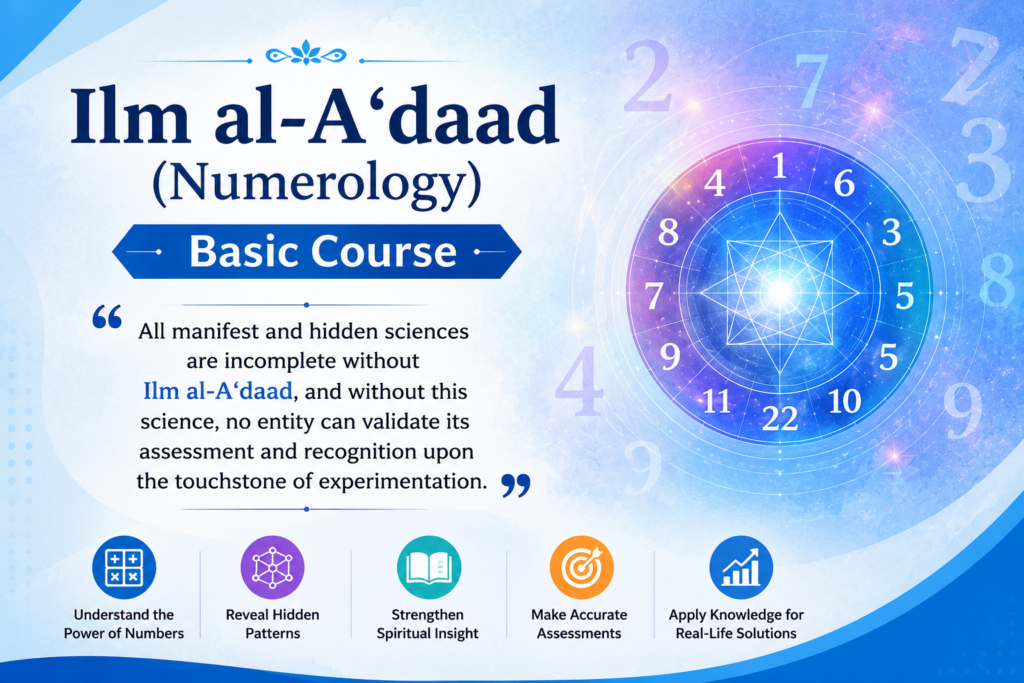 All manifest and hidden sciences are incomplete without Ilm al-A‘daad, and without this science, no entity can validate its assessment and recognition upon the touchstone of experimentation. For this very reason, the entire foundation of Ilm-e-Ramal, Ilm al-Jafr, and Ilm-e-Nujoom rests upon this science alone. The entire mechanism and operation of Uloom-e-Makhfiya relies explicitly upon Ilm al-A‘daad. Without this science, all other branches of knowledge remain incomplete and ineffective.
Every single number increases its influence through its permutations, addition, division, and multiplications—meaning, through this process, the specific effects of that number are amplified. No matter how vast the scale of numbers may be, they are ultimately structured by combining the numbers from one to nine. The number one represents the absolute beginning (Ibtida), and the number nine signifies
All manifest and hidden sciences are incomplete without Ilm al-A‘daad, and without this science, no entity can validate its assessment and recognition upon the touchstone of experimentation. For this very reason, the entire foundation of Ilm-e-Ramal, Ilm al-Jafr, and Ilm-e-Nujoom rests upon this science alone. The entire mechanism and operation of Uloom-e-Makhfiya relies explicitly upon Ilm al-A‘daad. Without this science, all other branches of knowledge remain incomplete and ineffective.
Every single number increases its influence through its permutations, addition, division, and multiplications—meaning, through this process, the specific effects of that number are amplified. No matter how vast the scale of numbers may be, they are ultimately structured by combining the numbers from one to nine. The number one represents the absolute beginning (Ibtida), and the number nine signifies 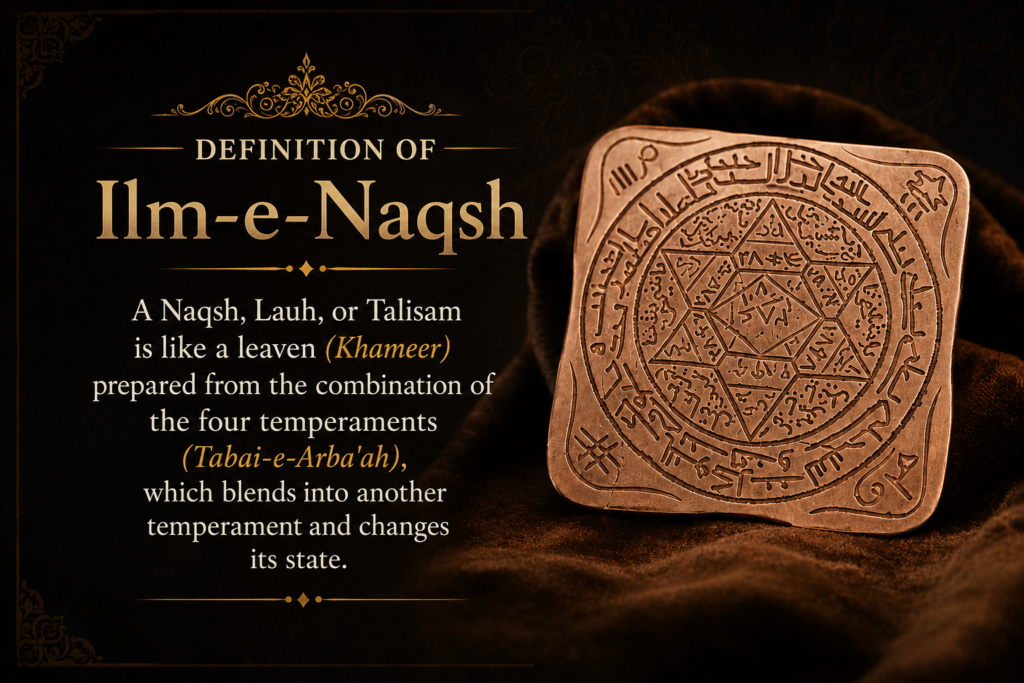 The era of the Sufiya had begun among Muslims. In this passion, various types of Riyazat and Mujahada were being practiced to lift the veils of the senses from the middle and generate Khawariq (extraordinary/miraculous) powers. Consequently, books and terminology for this art were compiled, and such perfection was achieved that they left their predecessors (Sabiqeen) behind. Imam Buni’s ؒ book "Shams al-Ma'arif" is considered a voluminous tome on these matters. Thus, when efforts and Riyazat were dedicated to the secrets and mysteries of letters (Huroof), the result emerged that the celestial souls (Arwah-e-Falaki) and planetary temperaments (Tabai-e-Kawkabi) are manifestations of the Divine Heavens. Since the secrets of letters (Asrar-e-Huroof) are running and permeating through all the Asma-e-Ilahi (Divine Names), the secret of letters also manifested within all creations and writings.
 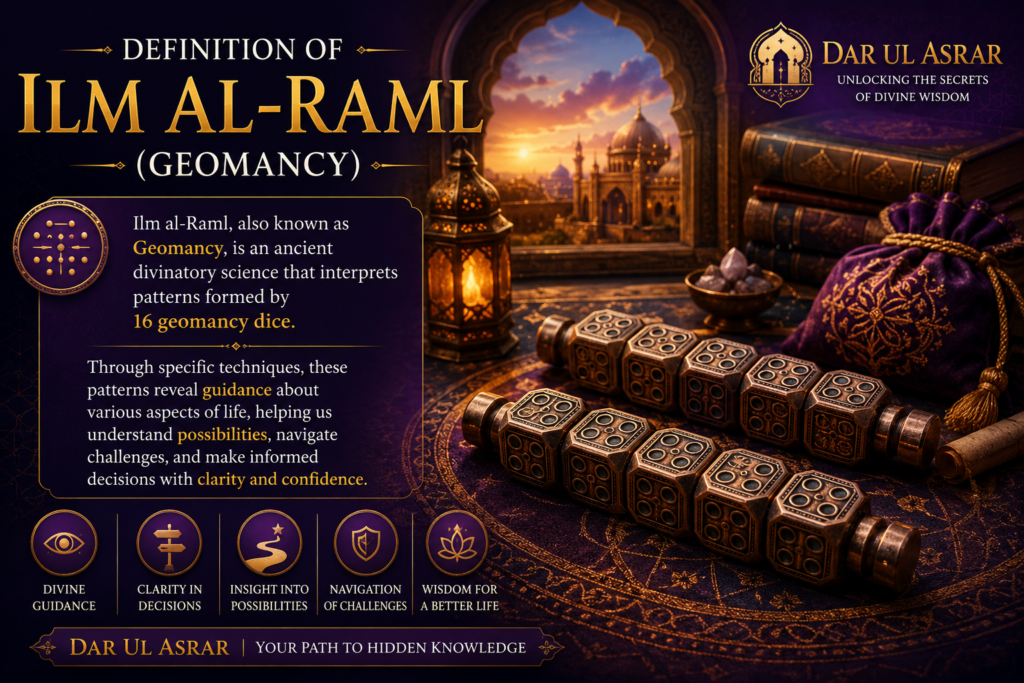 Mawlana Mahmood Ali Shafaq Rampuri on Ilm al-Raml
In his renowned book "Ilm al-Raml", Mawlana al-Hajj Mahmood Ali Shafaq Rampuri describes this sacred science as follows:
"Know that Ilm al-Raml is an extremely noble, authentic, and divinely transmitted knowledge passed down by the great saints and scholars. Some refer to it as a ‘Heavenly Science’ and consider it among the sciences of the prophets. Some scholars attribute it to Prophet Adam (علیہ السلام), others to Prophet Daniel (علیہ السلام), and some to Prophet Noah (علیہ السلام) or Prophet Idris (علیہ السلام). However, the reason for its divine revelation remains the same: whenever these prophets needed guidance about their offspring or specific life events, they prayed to Allah for knowledge that would reveal the unseen. In response, Angel Jibrael (علیہ السلام), by Allah’s command,
Mawlana Mahmood Ali Shafaq Rampuri on Ilm al-Raml
In his renowned book "Ilm al-Raml", Mawlana al-Hajj Mahmood Ali Shafaq Rampuri describes this sacred science as follows:
"Know that Ilm al-Raml is an extremely noble, authentic, and divinely transmitted knowledge passed down by the great saints and scholars. Some refer to it as a ‘Heavenly Science’ and consider it among the sciences of the prophets. Some scholars attribute it to Prophet Adam (علیہ السلام), others to Prophet Daniel (علیہ السلام), and some to Prophet Noah (علیہ السلام) or Prophet Idris (علیہ السلام). However, the reason for its divine revelation remains the same: whenever these prophets needed guidance about their offspring or specific life events, they prayed to Allah for knowledge that would reveal the unseen. In response, Angel Jibrael (علیہ السلام), by Allah’s command, 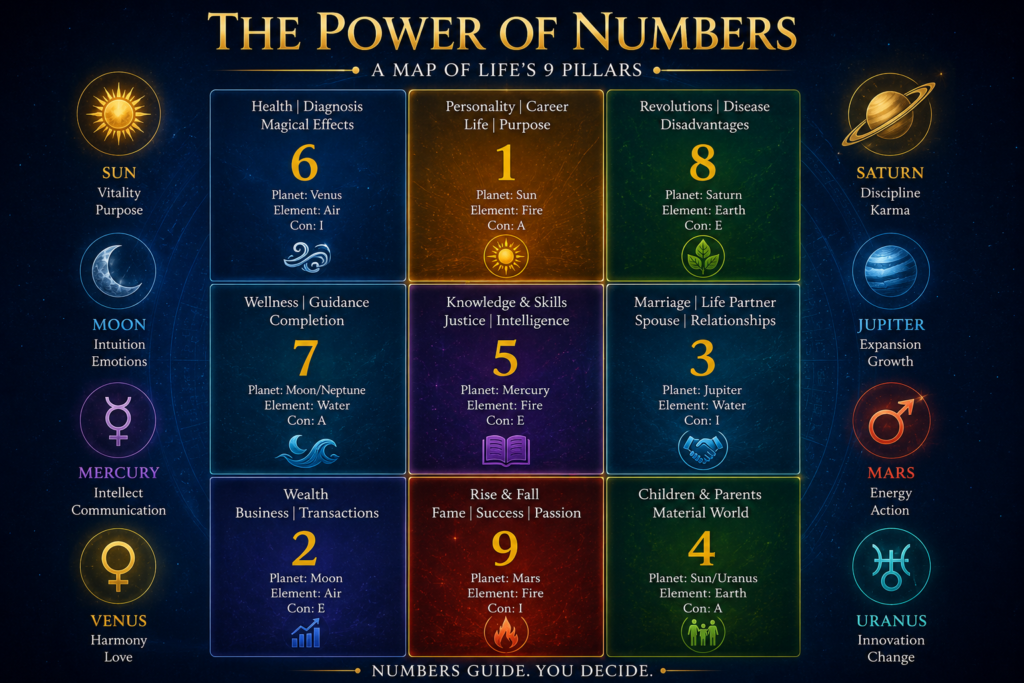 A numerology expert should be so proficient in this art that they can derive accurate answers to every question from the numerology chart. This is because a numerology chart is not just a mere chart but a secret book containing hidden clues about the past, present, and future. Each house in the chart continuously changes its state according to time and the nature of the question. The qualities of the numbers from 1 to 9, depending on the houses they occupy, also fluctuate throughout the day.
Each house in the chart has specific attributes. No number is inherently auspicious or inauspicious; however, due to its position and different statuses, a number can become either auspicious or inauspicious. This chart is designed in the form of a Mussallas. The extracted number is placed in the first house, and the remaining numbers are arranged sequentially in the corresponding houses.
Let's understand
A numerology expert should be so proficient in this art that they can derive accurate answers to every question from the numerology chart. This is because a numerology chart is not just a mere chart but a secret book containing hidden clues about the past, present, and future. Each house in the chart continuously changes its state according to time and the nature of the question. The qualities of the numbers from 1 to 9, depending on the houses they occupy, also fluctuate throughout the day.
Each house in the chart has specific attributes. No number is inherently auspicious or inauspicious; however, due to its position and different statuses, a number can become either auspicious or inauspicious. This chart is designed in the form of a Mussallas. The extracted number is placed in the first house, and the remaining numbers are arranged sequentially in the corresponding houses.
Let's understand