
 In the Arabic language, where the word Rizq conveys the meaning of daily bread and sustenance, it is also used to denote all forms of divine bounties. Accordingly, within the Holy Quran, it has been utilized for wealth and assets, for the provisions of life, and has also been used for guidance and spiritual gnosis (Hidayat-o-Ma'rifat). Briefly, we can state that the word Rizq is used for every single bounty bestowed upon the servants by Allah Almighty. Allah Almighty has commanded mankind in general, and Muslims in particular, to distinguish between Rizq-e-Halal (lawful sustenance) and Rizq-e-Haram (unlawful sustenance); earning a Halal livelihood and abstaining from Haram is just as essential as practicing Namaz, Roza (fasting), and other foundational obligations (Faraiz)... Yet, it is astonishing that even within Muslim societies, few people distinguish between Halal and Haram. Indeed, Read more [...]
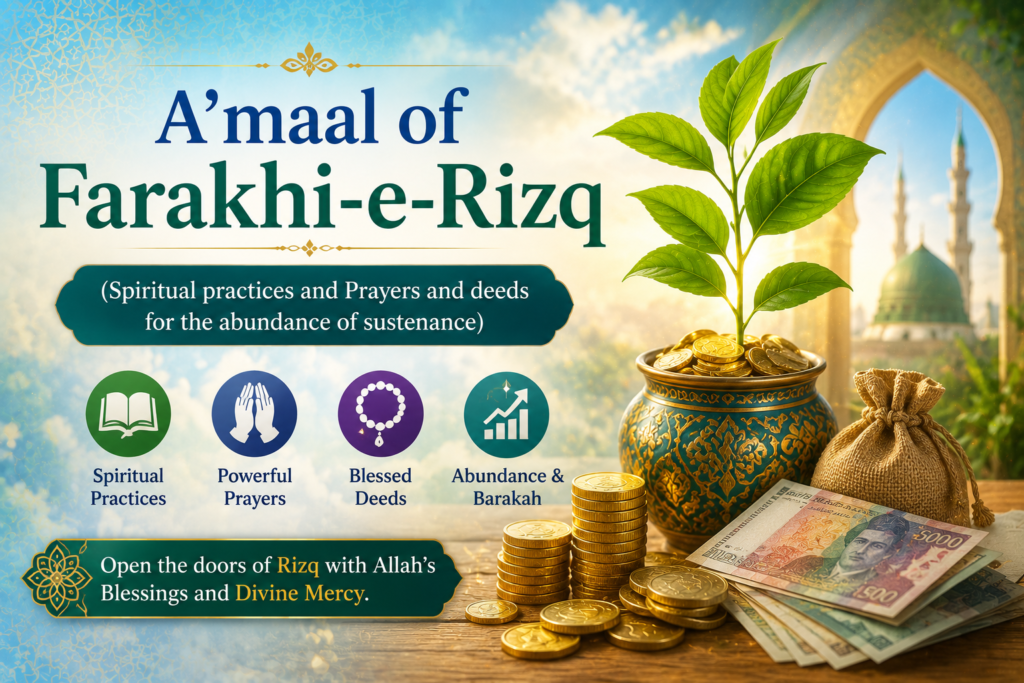
 A’maal baraye Farakhi-e-Rizq
In the Arabic language, where the word Rizq conveys the meaning of daily bread and sustenance, it is also used to denote all forms of divine bounties. Accordingly, within the Holy Quran, it has been utilized for wealth and assets, for the provisions of life, and has also been used for guidance and spiritual gnosis (Hidayat-o-Ma'rifat). Briefly, we can state that the word Rizq is used for every single bounty bestowed upon the servants by Allah Almighty. Allah Almighty has commanded mankind in general, and Muslims in particular, to distinguish between Rizq-e-Halal (lawful sustenance) and Rizq-e-Haram (unlawful sustenance); earning a Halal livelihood and abstaining from Haram is just as essential as practicing Namaz, Roza (fasting), and other foundational obligations (Faraiz)... Yet, it is astonishing that even within Muslim societies, few people distinguish between Halal and Haram. Indeed, Read more [...]