

 Muraqaba is a sufi term that means fear, to inspect, to watch over, to take care of, to control, to look at one’s inner world, to be entranced, to think of the aim at all times, to look at Allah with the heart at all times, to keep the soul under control in order to protect the heart from bad deeds, to know that Lord knows every state of a person, to dismiss everything from one’s mind and be ready to receive inspiration from Allah by kneeling down and closing the eyes.
The gist of the teachings of the prophets of Allah is that man after negating the fictional sight, should equip himself with that sight which witnesses the reality. Entering into one after leaving the other or getting something after quitting the other is only possible when we can disunite ourselves from that which is to be quitted. This act of disuniting ourselves, in terms of spirituality, is called negation. And when Read more [...]
Muraqaba is a sufi term that means fear, to inspect, to watch over, to take care of, to control, to look at one’s inner world, to be entranced, to think of the aim at all times, to look at Allah with the heart at all times, to keep the soul under control in order to protect the heart from bad deeds, to know that Lord knows every state of a person, to dismiss everything from one’s mind and be ready to receive inspiration from Allah by kneeling down and closing the eyes.
The gist of the teachings of the prophets of Allah is that man after negating the fictional sight, should equip himself with that sight which witnesses the reality. Entering into one after leaving the other or getting something after quitting the other is only possible when we can disunite ourselves from that which is to be quitted. This act of disuniting ourselves, in terms of spirituality, is called negation. And when Read more [...] Understanding of Muraqabah
Muraqaba is a sufi term that means fear, to inspect, to watch over, to take care of, to control, to look at one’s inner world, to be entranced, to think of the aim at all times, to look at Allah with the heart at all times, to keep the soul under control in order to protect the heart from bad deeds, to know that Lord knows every state of a person, to dismiss everything from one’s mind and be ready to receive inspiration from Allah by kneeling down and closing the eyes.
The gist of the teachings of the prophets of Allah is that man after negating the fictional sight, should equip himself with that sight which witnesses the reality. Entering into one after leaving the other or getting something after quitting the other is only possible when we can disunite ourselves from that which is to be quitted. This act of disuniting ourselves, in terms of spirituality, is called negation. And when Read more [...]  Today most of people calling a spiritual one as “SUFI” . Even a meditation guy or girl also calling himself a Sufi… so the word “SUFI” has been misunderstood in today’s society. The word SUFI defines a thought-form which believes in oneness, but Islamic Sufi is not a Sufi without practicing Shariah. Islam has no SUFISM but a proper and powerful islamic branch of Tasawwuf.
Tasawwuf is a branch of Islamic knowledge which focuses on the spiritual development of the Muslim.
Allah sent His final messenger, Prophet Muhammad ﷺ, as a source of knowledge for the entire ummah. He was the fountain of Quran, Hadith, tafsir, rhetoric, fiqh, and so on. After the Prophet, the scholars of this ummah carried and propagated each of these branches of knowledge. Because no one person can attain the perfection of the Prophet ﷺ , who single handedly assumed all of these roles, various branches
Today most of people calling a spiritual one as “SUFI” . Even a meditation guy or girl also calling himself a Sufi… so the word “SUFI” has been misunderstood in today’s society. The word SUFI defines a thought-form which believes in oneness, but Islamic Sufi is not a Sufi without practicing Shariah. Islam has no SUFISM but a proper and powerful islamic branch of Tasawwuf.
Tasawwuf is a branch of Islamic knowledge which focuses on the spiritual development of the Muslim.
Allah sent His final messenger, Prophet Muhammad ﷺ, as a source of knowledge for the entire ummah. He was the fountain of Quran, Hadith, tafsir, rhetoric, fiqh, and so on. After the Prophet, the scholars of this ummah carried and propagated each of these branches of knowledge. Because no one person can attain the perfection of the Prophet ﷺ , who single handedly assumed all of these roles, various branches  Sufism is a way of life in which a deeper identity is discovered and lived. This deeper identity, beyond the already known personality, is in harmony with all that exists. This deeper identity, or essential self, has abilities of awareness, action, creativity and love that are far beyond the abilities of the superficial personality. Eventually it is understood that these abilities belong to a greater life and being which we individualize in our own unique way while never being separate from it.
Sufism is less a doctrine or a belief system than an experience and way of life. It is a tradition of enlightenment that carries the essential truth forward through time. Tradition, however, must be conceived in a vital and dynamic sense. Its expression must not remain limited to the religious and cultural forms of the past. The truth of Sufism requires reformulation and fresh expression in every
Sufism is a way of life in which a deeper identity is discovered and lived. This deeper identity, beyond the already known personality, is in harmony with all that exists. This deeper identity, or essential self, has abilities of awareness, action, creativity and love that are far beyond the abilities of the superficial personality. Eventually it is understood that these abilities belong to a greater life and being which we individualize in our own unique way while never being separate from it.
Sufism is less a doctrine or a belief system than an experience and way of life. It is a tradition of enlightenment that carries the essential truth forward through time. Tradition, however, must be conceived in a vital and dynamic sense. Its expression must not remain limited to the religious and cultural forms of the past. The truth of Sufism requires reformulation and fresh expression in every  His personal name was Hasan, while his titles included Mu‘in al-Din, Mu‘in al-Awliya, Khalifat al-Rasul fi al-Hind, Hind al-Wali, Shahanshah-e-Mashaikh, Sultan al-‘Arifin, Burhan al-‘Ashiqin, Shaykh al-Islam, Gharib Nawaz, Sultan al-Hind, Na’ib Rasul fi al-Hind, and Sadr-e-Bazm-e-Chishtiyan.
He was both حسنی and حسینی, and his noble lineage reaches Amir al-Mu’minin حضرت علی المرتضیؓ in the thirteenth generation.
He was born in the region of Sijistan in 537 AH / 1139 CE. For this reason, some biographers referred to him as “Sijzi,” and he became widely known as Hasan Sijzi.
For the first eleven years of his life, he was raised in great comfort and prosperity. After the passing of his respected father, his inheritance included a garden and other property, through which he lived peacefully and comfortably.
One day, while seated in his garden, a majdhub
His personal name was Hasan, while his titles included Mu‘in al-Din, Mu‘in al-Awliya, Khalifat al-Rasul fi al-Hind, Hind al-Wali, Shahanshah-e-Mashaikh, Sultan al-‘Arifin, Burhan al-‘Ashiqin, Shaykh al-Islam, Gharib Nawaz, Sultan al-Hind, Na’ib Rasul fi al-Hind, and Sadr-e-Bazm-e-Chishtiyan.
He was both حسنی and حسینی, and his noble lineage reaches Amir al-Mu’minin حضرت علی المرتضیؓ in the thirteenth generation.
He was born in the region of Sijistan in 537 AH / 1139 CE. For this reason, some biographers referred to him as “Sijzi,” and he became widely known as Hasan Sijzi.
For the first eleven years of his life, he was raised in great comfort and prosperity. After the passing of his respected father, his inheritance included a garden and other property, through which he lived peacefully and comfortably.
One day, while seated in his garden, a majdhub 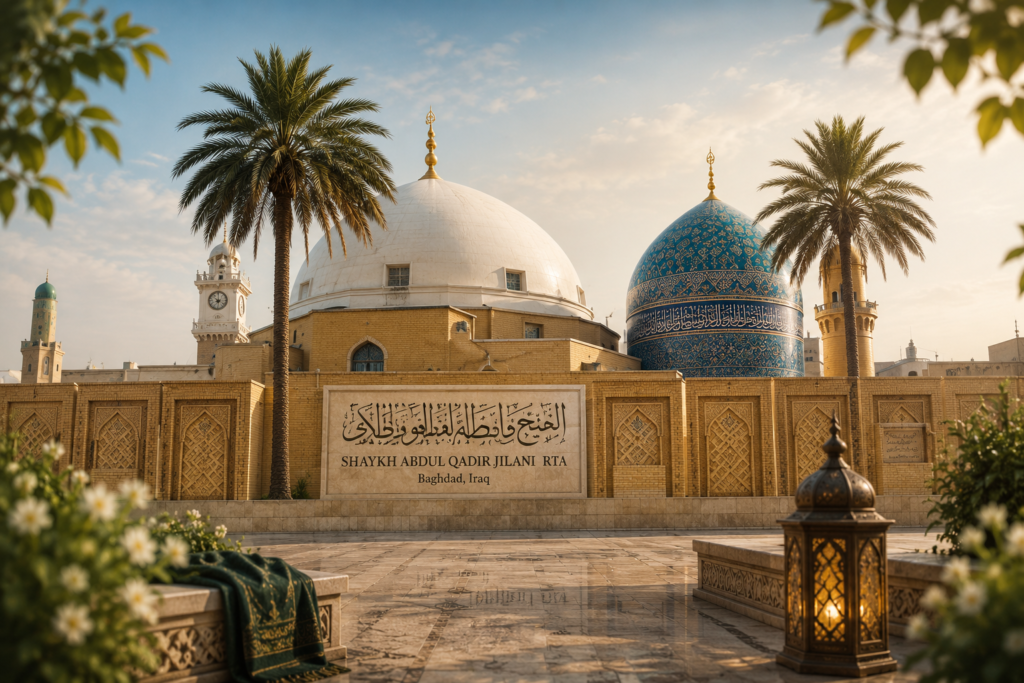 Life and Teachings
Shaykh Abdul Qadir Jilani علیہ الرحمہ was a great عالمِ باعمل and a devoted follower of Shariyah, as well as a distinguished ولی اللہ. His spiritual rank and ولایت become evident through his own books and teachings.
His full name was عبدالقادر بن ابو صالح عبداللہ بن جنکی دومت الجیلی (الجیلانی). His kunyah was ابو محمد, while his titles included محی الدین and شیخ الاسلام. He followed the Hanbali madhhab and his عقائد were those of اہل السنۃ والجماعۃ. He himself stated:
“Our عقیدہ is the same as that of all صحابۂ کرام and سلفِ صالحین.”
He was a حسینی Sayyid through his mother’s lineage and a حسنی Sayyid through his father’s lineage. According to Bahjat al-Asrar and Nafahat al-Uns, his blessed lineage
Life and Teachings
Shaykh Abdul Qadir Jilani علیہ الرحمہ was a great عالمِ باعمل and a devoted follower of Shariyah, as well as a distinguished ولی اللہ. His spiritual rank and ولایت become evident through his own books and teachings.
His full name was عبدالقادر بن ابو صالح عبداللہ بن جنکی دومت الجیلی (الجیلانی). His kunyah was ابو محمد, while his titles included محی الدین and شیخ الاسلام. He followed the Hanbali madhhab and his عقائد were those of اہل السنۃ والجماعۃ. He himself stated:
“Our عقیدہ is the same as that of all صحابۂ کرام and سلفِ صالحین.”
He was a حسینی Sayyid through his mother’s lineage and a حسنی Sayyid through his father’s lineage. According to Bahjat al-Asrar and Nafahat al-Uns, his blessed lineage  Some scholars have divided the Sufis into three categories:
صوفی
متصوف
مستصوف
Their explanations are briefly described as follows:
صوفی
A صاحبِ وصول — one who has become free from the demands of the lower nature, has become connected with the Truth, and after becoming فنا from his own self, remains alive and enduring through the حق.
متصوف
A صاحبِ اصول — one who is engaged in مجاہدہ and striving to reach the station of وصول.
مستصوف
A صاحبِ فضول — one who adopts the outward appearance of the Sufis for worldly gain, while having attained no share from the true perfections and qualities of the صوفیہ.
Apart from the divisions mentioned above, there are also other titles by which the Sufis are known, such as ملامتیہ and قلندر.
ملامتیہ
ملامتیہ refers to that
Some scholars have divided the Sufis into three categories:
صوفی
متصوف
مستصوف
Their explanations are briefly described as follows:
صوفی
A صاحبِ وصول — one who has become free from the demands of the lower nature, has become connected with the Truth, and after becoming فنا from his own self, remains alive and enduring through the حق.
متصوف
A صاحبِ اصول — one who is engaged in مجاہدہ and striving to reach the station of وصول.
مستصوف
A صاحبِ فضول — one who adopts the outward appearance of the Sufis for worldly gain, while having attained no share from the true perfections and qualities of the صوفیہ.
Apart from the divisions mentioned above, there are also other titles by which the Sufis are known, such as ملامتیہ and قلندر.
ملامتیہ
ملامتیہ refers to that  Allah تعالیٰ says:
“وَالَّذِينَ جَاهَدُوا فِينَا لَنَهْدِيَنَّهُمْ سُبُلَنَا”(Surah Al-‘Ankabūt)
Meaning: Those who strive in Our path — We shall surely guide them to Our ways.
With complete اعتمادِ کلّی upon this Divine promise, the Sufis engage in مجاہدہ and thereby attain guidance. Guidance depends upon شرحِ صدر, and شرحِ صدر results from those Divine lights (انوارِ الٰہی) which descend from the unseen upon the heart.
Through the blessings of these انوارِ الٰہی, and through the wisdom that springs forth in the chest due to زہد فی الدنیا and قلتِ کلام, the Sufi attains from Allah a بصیرت from which others remain deprived. They are granted such understanding and perception as lies beyond the reach of ordinary people. By means of this بصیرت,
Allah تعالیٰ says:
“وَالَّذِينَ جَاهَدُوا فِينَا لَنَهْدِيَنَّهُمْ سُبُلَنَا”(Surah Al-‘Ankabūt)
Meaning: Those who strive in Our path — We shall surely guide them to Our ways.
With complete اعتمادِ کلّی upon this Divine promise, the Sufis engage in مجاہدہ and thereby attain guidance. Guidance depends upon شرحِ صدر, and شرحِ صدر results from those Divine lights (انوارِ الٰہی) which descend from the unseen upon the heart.
Through the blessings of these انوارِ الٰہی, and through the wisdom that springs forth in the chest due to زہد فی الدنیا and قلتِ کلام, the Sufi attains from Allah a بصیرت from which others remain deprived. They are granted such understanding and perception as lies beyond the reach of ordinary people. By means of this بصیرت,