
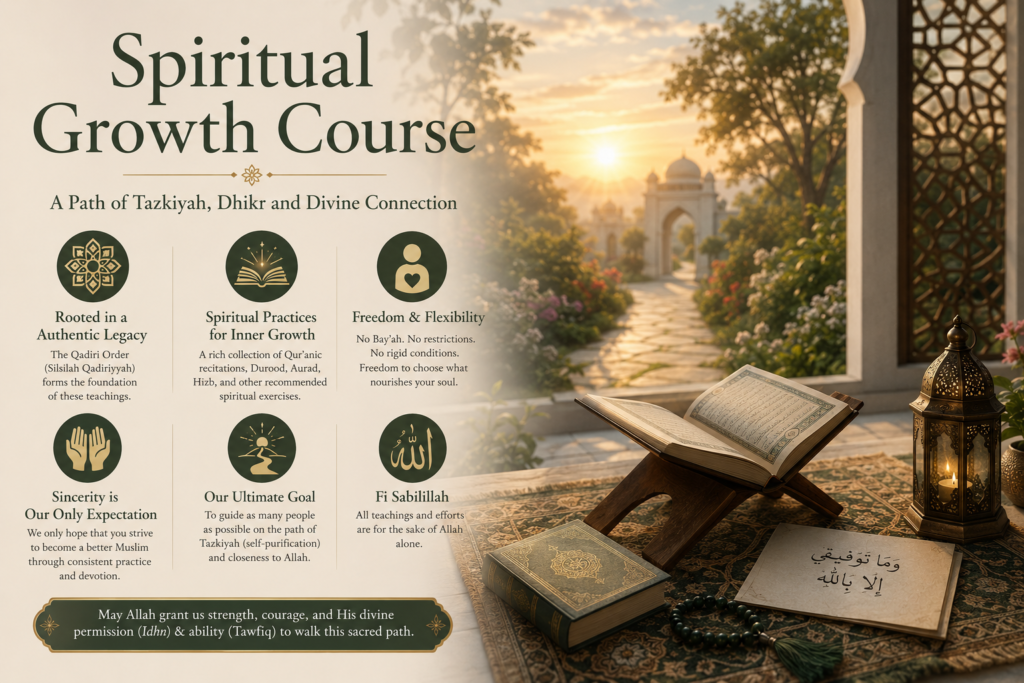
 The purpose of the Spiritual Growth Course is to assist anyone who finds themselves at a standstill on their spiritual journey and is in search of guidance to progress beyond their current state and advance to even higher spiritual levels. It must be clearly stated that, in our view, the highest spiritual station is the Station of Servitude (Maqām-e-‘Abdiyyat), which signifies closeness to Allah.
Every Muslim should strive for continuous growth so that at some point in their life, they become capable of attaining this esteemed station.
Another important point to consider is that when discussing spiritual ranks, terms like Ghawth (Helper), Qutb (Axis), Abdal (Substitutes), and Awtad (Pillars) are commonly mentioned. However, these designations are related to administrative spiritual responsibilities rather than personal spiritual advancement. They should not be linked to spiritual stations Read more [...]
The purpose of the Spiritual Growth Course is to assist anyone who finds themselves at a standstill on their spiritual journey and is in search of guidance to progress beyond their current state and advance to even higher spiritual levels. It must be clearly stated that, in our view, the highest spiritual station is the Station of Servitude (Maqām-e-‘Abdiyyat), which signifies closeness to Allah.
Every Muslim should strive for continuous growth so that at some point in their life, they become capable of attaining this esteemed station.
Another important point to consider is that when discussing spiritual ranks, terms like Ghawth (Helper), Qutb (Axis), Abdal (Substitutes), and Awtad (Pillars) are commonly mentioned. However, these designations are related to administrative spiritual responsibilities rather than personal spiritual advancement. They should not be linked to spiritual stations Read more [...] Spiritual Growth Course (FREE)
The purpose of the Spiritual Growth Course is to assist anyone who finds themselves at a standstill on their spiritual journey and is in search of guidance to progress beyond their current state and advance to even higher spiritual levels. It must be clearly stated that, in our view, the highest spiritual station is the Station of Servitude (Maqām-e-‘Abdiyyat), which signifies closeness to Allah.
Every Muslim should strive for continuous growth so that at some point in their life, they become capable of attaining this esteemed station.
Another important point to consider is that when discussing spiritual ranks, terms like Ghawth (Helper), Qutb (Axis), Abdal (Substitutes), and Awtad (Pillars) are commonly mentioned. However, these designations are related to administrative spiritual responsibilities rather than personal spiritual advancement. They should not be linked to spiritual stations Read more [...] 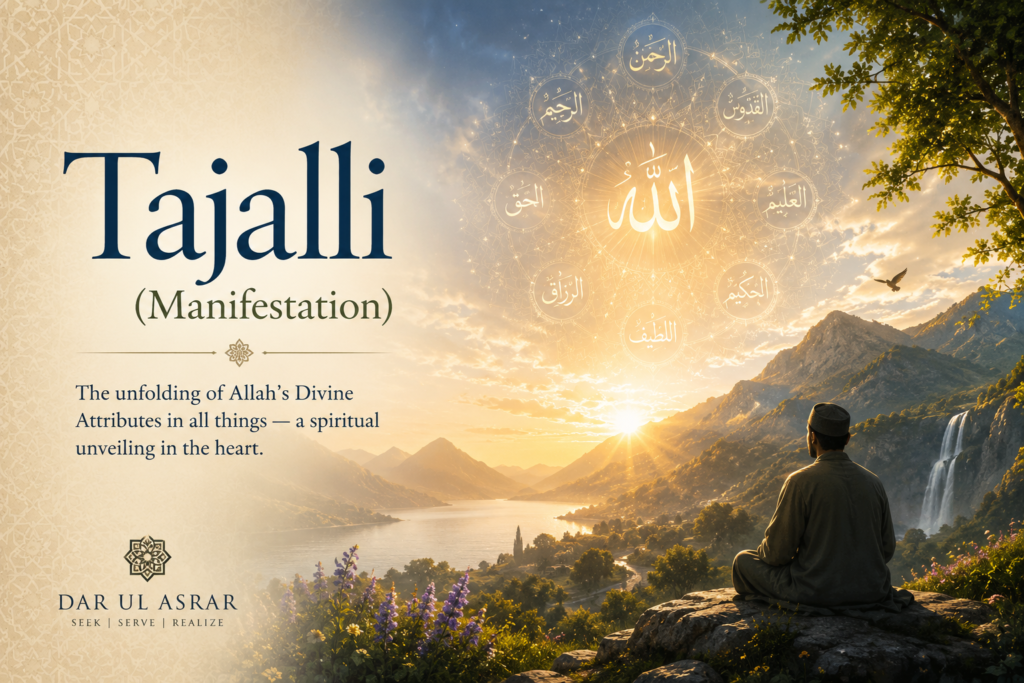 The word Tajalli has many meanings. It is usually translated as manifestation, unveiling, or reflection. In this specific context, Tajalli refers to the various manifestations of Allah’s Divine Attributes and to the unveiling of their mysteries in the heart. Everything created is a sign of Allah, and if we look beyond the physical, we would see that everything in existence is connected to Him and there is nothing that is not dependent on Him. As such, all things in the universe are proof that He is our Creator and our Lord; they are manifestations or reflections of His Divine act of creation and are sustained by Him. Thus, they are all signs pointing to His presence.
Alternatively, Tajalli refers to the spiritual and mental experience in which a lover of God becomes acutely aware of this presence. All things, no doubt, are reflecting the Divine Attributes, but we rarely see them as
The word Tajalli has many meanings. It is usually translated as manifestation, unveiling, or reflection. In this specific context, Tajalli refers to the various manifestations of Allah’s Divine Attributes and to the unveiling of their mysteries in the heart. Everything created is a sign of Allah, and if we look beyond the physical, we would see that everything in existence is connected to Him and there is nothing that is not dependent on Him. As such, all things in the universe are proof that He is our Creator and our Lord; they are manifestations or reflections of His Divine act of creation and are sustained by Him. Thus, they are all signs pointing to His presence.
Alternatively, Tajalli refers to the spiritual and mental experience in which a lover of God becomes acutely aware of this presence. All things, no doubt, are reflecting the Divine Attributes, but we rarely see them as 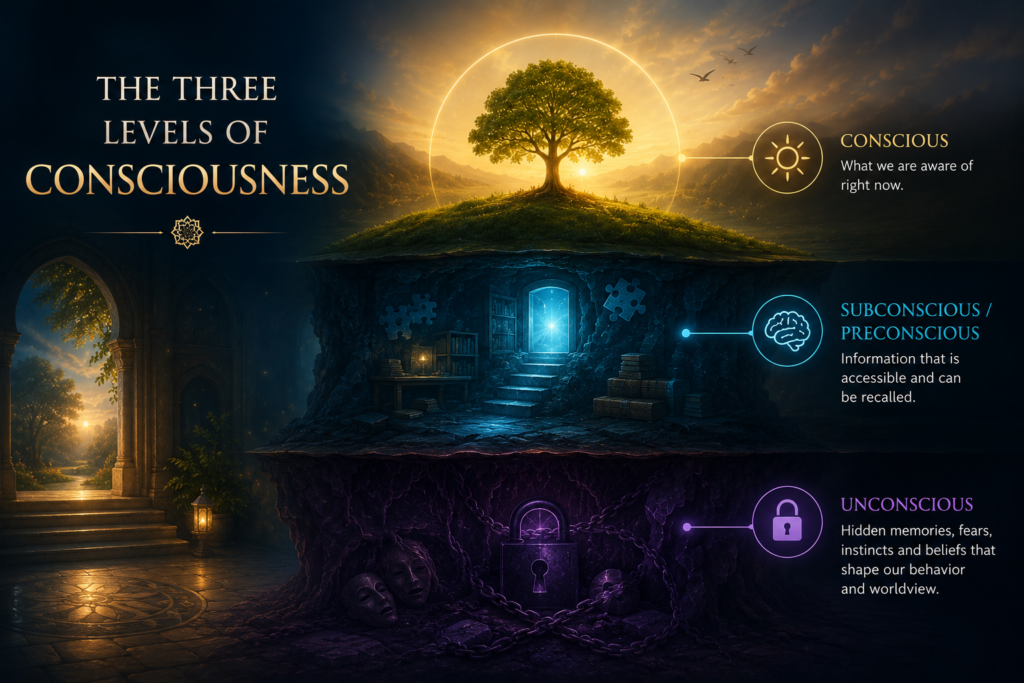 The human mind can be divided into three levels of consciousness.
These are:
The Conscious: This is the level of awareness. It includes whatever you are aware of at the current moment and the mental processes and thoughts that are going on alongside that. For example, whatever you are seeing, thinking about, and the feeling of sitting on a chair are all examples of the conscious mind.
The Subconscious/Preconscious: This is the level of accessible memory. It contains all of that information which can be recalled and remembered at will. For example, if you need to remember a specific path, you can recall it as soon as you need.
The Unconscious: This consists of our instinctive wishes as well as information that cannot be recalled. It includes bad memories, traumas, unfulfilled wishes, and other information that has been locked up inside. Much of what is in the unconscious affects us
The human mind can be divided into three levels of consciousness.
These are:
The Conscious: This is the level of awareness. It includes whatever you are aware of at the current moment and the mental processes and thoughts that are going on alongside that. For example, whatever you are seeing, thinking about, and the feeling of sitting on a chair are all examples of the conscious mind.
The Subconscious/Preconscious: This is the level of accessible memory. It contains all of that information which can be recalled and remembered at will. For example, if you need to remember a specific path, you can recall it as soon as you need.
The Unconscious: This consists of our instinctive wishes as well as information that cannot be recalled. It includes bad memories, traumas, unfulfilled wishes, and other information that has been locked up inside. Much of what is in the unconscious affects us 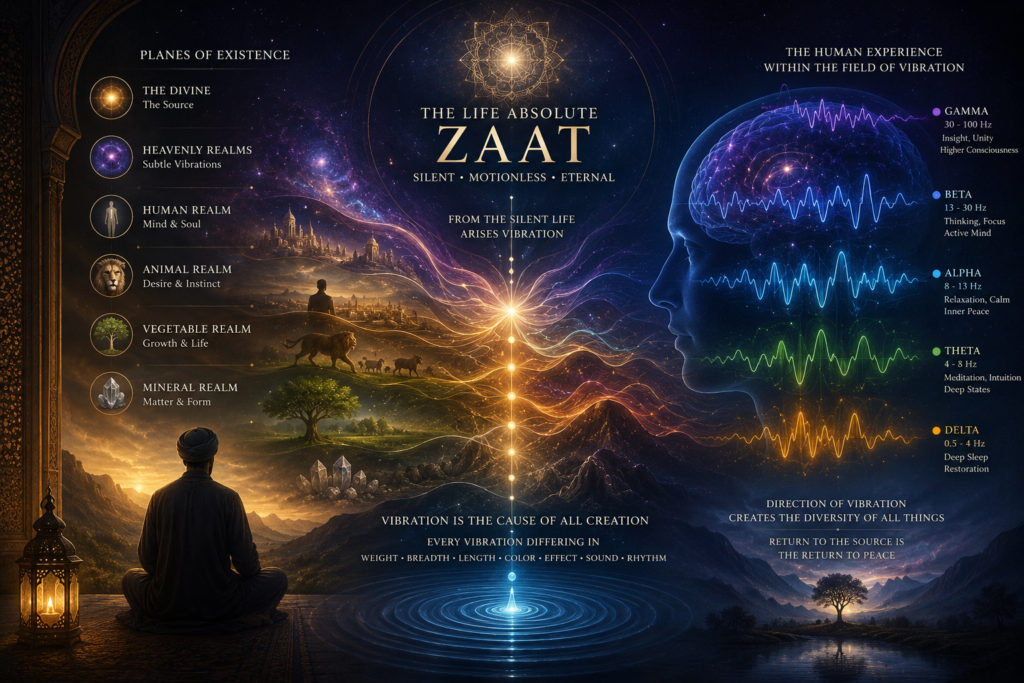 The Life Absolute from which has sprung all that is felt, seen, and perceived, and into which all again merges in time, is a silent, motionless and eternal life which among the Sufis is called Zaat. Every motion that springs forth from this silent life is a vibration and a creator of vibrations. Within one vibration are created many vibrations; as motion causes motion so the silent life becomes active in a certain part, and creates every moment more and more activity, losing thereby the peace of the original silent life. It is the grade of activity of these vibrations that accounts for the various planes of existence. These planes are imagined to differ from one another, but in reality they cannot be entirely detached and made separate from one another. The activity of vibrations makes them grosser, and thus the earth is born of the heavens.
The mineral, vegetable, animal and human kingdoms
The Life Absolute from which has sprung all that is felt, seen, and perceived, and into which all again merges in time, is a silent, motionless and eternal life which among the Sufis is called Zaat. Every motion that springs forth from this silent life is a vibration and a creator of vibrations. Within one vibration are created many vibrations; as motion causes motion so the silent life becomes active in a certain part, and creates every moment more and more activity, losing thereby the peace of the original silent life. It is the grade of activity of these vibrations that accounts for the various planes of existence. These planes are imagined to differ from one another, but in reality they cannot be entirely detached and made separate from one another. The activity of vibrations makes them grosser, and thus the earth is born of the heavens.
The mineral, vegetable, animal and human kingdoms 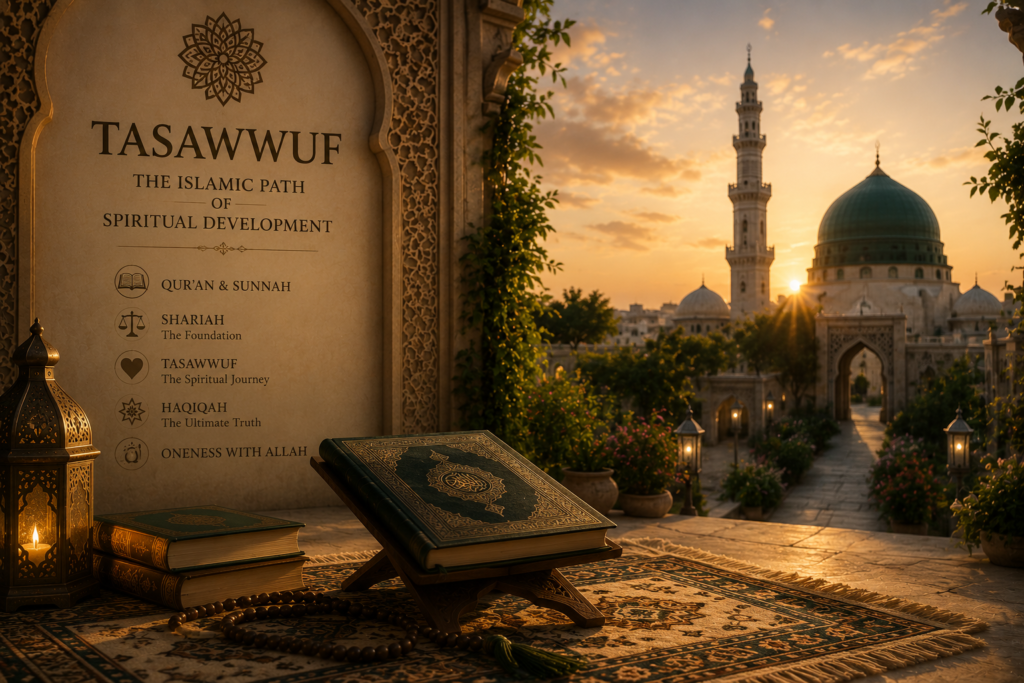 Today most of people calling a spiritual one as “SUFI” . Even a meditation guy or girl also calling himself a Sufi… so the word “SUFI” has been misunderstood in today’s society. The word SUFI defines a thought-form which believes in oneness, but Islamic Sufi is not a Sufi without practicing Shariah. Islam has no SUFISM but a proper and powerful islamic branch of Tasawwuf.
Tasawwuf is a branch of Islamic knowledge which focuses on the spiritual development of the Muslim.
Allah sent His final messenger, Prophet Muhammad ﷺ, as a source of knowledge for the entire ummah. He was the fountain of Quran, Hadith, tafsir, rhetoric, fiqh, and so on. After the Prophet, the scholars of this ummah carried and propagated each of these branches of knowledge. Because no one person can attain the perfection of the Prophet ﷺ , who single handedly assumed all of these roles, various branches
Today most of people calling a spiritual one as “SUFI” . Even a meditation guy or girl also calling himself a Sufi… so the word “SUFI” has been misunderstood in today’s society. The word SUFI defines a thought-form which believes in oneness, but Islamic Sufi is not a Sufi without practicing Shariah. Islam has no SUFISM but a proper and powerful islamic branch of Tasawwuf.
Tasawwuf is a branch of Islamic knowledge which focuses on the spiritual development of the Muslim.
Allah sent His final messenger, Prophet Muhammad ﷺ, as a source of knowledge for the entire ummah. He was the fountain of Quran, Hadith, tafsir, rhetoric, fiqh, and so on. After the Prophet, the scholars of this ummah carried and propagated each of these branches of knowledge. Because no one person can attain the perfection of the Prophet ﷺ , who single handedly assumed all of these roles, various branches  Sufism is a way of life in which a deeper identity is discovered and lived. This deeper identity, beyond the already known personality, is in harmony with all that exists. This deeper identity, or essential self, has abilities of awareness, action, creativity and love that are far beyond the abilities of the superficial personality. Eventually it is understood that these abilities belong to a greater life and being which we individualize in our own unique way while never being separate from it.
Sufism is less a doctrine or a belief system than an experience and way of life. It is a tradition of enlightenment that carries the essential truth forward through time. Tradition, however, must be conceived in a vital and dynamic sense. Its expression must not remain limited to the religious and cultural forms of the past. The truth of Sufism requires reformulation and fresh expression in every
Sufism is a way of life in which a deeper identity is discovered and lived. This deeper identity, beyond the already known personality, is in harmony with all that exists. This deeper identity, or essential self, has abilities of awareness, action, creativity and love that are far beyond the abilities of the superficial personality. Eventually it is understood that these abilities belong to a greater life and being which we individualize in our own unique way while never being separate from it.
Sufism is less a doctrine or a belief system than an experience and way of life. It is a tradition of enlightenment that carries the essential truth forward through time. Tradition, however, must be conceived in a vital and dynamic sense. Its expression must not remain limited to the religious and cultural forms of the past. The truth of Sufism requires reformulation and fresh expression in every  Some scholars have divided the Sufis into three categories:
صوفی
متصوف
مستصوف
Their explanations are briefly described as follows:
صوفی
A صاحبِ وصول — one who has become free from the demands of the lower nature, has become connected with the Truth, and after becoming فنا from his own self, remains alive and enduring through the حق.
متصوف
A صاحبِ اصول — one who is engaged in مجاہدہ and striving to reach the station of وصول.
مستصوف
A صاحبِ فضول — one who adopts the outward appearance of the Sufis for worldly gain, while having attained no share from the true perfections and qualities of the صوفیہ.
Apart from the divisions mentioned above, there are also other titles by which the Sufis are known, such as ملامتیہ and قلندر.
ملامتیہ
ملامتیہ refers to that
Some scholars have divided the Sufis into three categories:
صوفی
متصوف
مستصوف
Their explanations are briefly described as follows:
صوفی
A صاحبِ وصول — one who has become free from the demands of the lower nature, has become connected with the Truth, and after becoming فنا from his own self, remains alive and enduring through the حق.
متصوف
A صاحبِ اصول — one who is engaged in مجاہدہ and striving to reach the station of وصول.
مستصوف
A صاحبِ فضول — one who adopts the outward appearance of the Sufis for worldly gain, while having attained no share from the true perfections and qualities of the صوفیہ.
Apart from the divisions mentioned above, there are also other titles by which the Sufis are known, such as ملامتیہ and قلندر.
ملامتیہ
ملامتیہ refers to that