
 In the contemporary era, every single individual is entangled in one distress or another. Someone faces livelihood issues, somewhere there is an impediment in marriage, another is a victim of a commercial Bandish (binding), while yet another is seeking deliverance from Aseebi (demonic/jinn) afflictions. It appears as though every person is Sihr-zada (spellbound). There is a Bandish on everyone; everyone’s relative is consumed by jealousy (Hasad) and is getting Jadu (magic) executed upon them. The situation has degraded to the extent that even if a minor injury is sustained, it is suspected to be the result of Jadu. We too are a strange people; when we are prosperous, we do whatever our heart desires, but the moment we are surrounded by tribulations, we remember God. It is then that Istikhara is sought, and heaps of Bandishes and obstacles are uncovered. Then, Taweezat (amulets) are worn, and the consistency of Awrad (litanies) is maintained. Yet, we still lack awareness. Neither did we make an effort, nor did we desire to reform ourselves; we prefer to remain content in our misguidance.
We are entirely devoid of research (Tahqeeq). We are merely seekers of ease. Whatever we are given—whether good or bad—we accept it; we have but a single objective: that by any means, the problem must be resolved. No matter what the nature of the Amal (ritual) or Taweez is, we possess no discrimination between what is Jaiz (permissible) and Na-jaiz (impermissible).
It is critically vital to understand that the root cause of our tribulations could very well be an Amal performed in ignorance, or a specific Taweez that is Ghair-Shar’i (un-Islamic).
There are two forms to this: The first is like the Huroof-e-Muqatta’at (disjointed letters) in the Holy Quran, or those transmitted from the Ahadith and the elders of the faith (Buzurgan-e-Deen)—making Taweezat from these is Jaiz. The second is those which belong to other languages; until the true meaning of those words is accurately known, it is not Jaiz to construct Taweezat from them—neither from their numerical values (A’dad) nor from their words—as there remains a strong probability (Ihtimal) of their meanings being malicious (Sharr) or blasphemous (Kufri).
It is precisely for this reason that it is not Jaiz to recite (Wird) or provide a Taweez containing words whose meanings are Khilaf-e-Shar’ah (contrary to Islamic law). In accordance with the glorious command of the Master of Both Worlds ﷺ:
Hadhrat Awf ibn Malik al-Ashja’i narrates: “We used to practice incantations (Jhadr-Phonk) in the era of ignorance (Jahiliyyah). We asked the Messenger of Allah ﷺ about this. He ﷺ instructed: ‘Present your incantations (Afsoon/Mantars) to me. If they do not contain Shirk (polytheism) or Kufr (disbelief), they are Jaiz; otherwise, they are Haram (forbidden) and Kufr.'” (Muslim)
Hadhrat Abdullah bin Mas’ood (رضی اللہ عنہ) narrates: “I heard the Messenger of Allah ﷺ stating: ‘Incantations (Afsoon), spells (Tone), and amulets (Taweez) that contain malicious or polytheistic words—practicing them is Shirk.'” (Mishkat)
How Much Belief to Place in Amliyat and Taweezat?
The concise answer to this question is that one should place only as much belief in Amliyat (spiritual rituals) and Taweezat (amulets) as one places in conventional medicine. The only distinction is that while conventional medicine carries a probability of side effects or harm, Taweezat, Amliyat, or the consistent recitation (Mudawamat) of Noori Ilm (divine/pure spiritual knowledge) carry absolutely no probability of harm. Instead, they hold a significantly higher probability of benefit because they are formulated strictly from the Beautiful Names of Allah (Asma-ul-Husna) or the verses (Ayat) of the Book of Allah. For this purpose, it is also highly essential that a person learns the fundamental and core principles of this science (Ilm), such as calculating the numerical values (A’dad) of one’s own name or the A’dad of a blessed attribute of Allah, and then masters the art of practicing their consistency.
According to a historical parable, one day an elderly woman presented herself in the court of Qutb-ul-Aqtab Hazrat Baba Fariduddin Ganj Shakar (نور اللہ مرقدہ) and pleaded, “I am a widow, and my daughter has reached marriageable age. I need to arrange her marriage, but I possess absolutely nothing. Please, assist me.” Hazrat Baba Sahib (رحمتہ اللہ علیہ) instructed her, “Go and bring a small lump of clay.” The woman assumed that he was requesting the clay for the purpose of purification (Istinja), so she picked up a small lump and brought it to him. Baba Sahib (رحمتہ اللہ علیہ) took it in his blessed hand, recited Surah Al-Ikhlas three times, and blew (Damm) upon the clay—instantly, that piece of clay transformed into a solid lump of gold. Baba Sahib (رحمتہ اللہ علیہ) then said, “O mother, go and arrange your daughter’s marriage.”
The woman thought to herself, “How wondrous! I have received the gold, and I have also discovered the exact formula for making gold.”
Upon returning home, the woman placed a significantly large clod of clay in front of her and spent the entire night reciting Surah Al-Ikhlas and blowing upon it. However, when she looked at it in the morning, it was still mere clay. She returned to the service of Hazrat Baba Sahib (رحمتہ اللہ علیہ) and submitted, “O Baba Ji, you merely recited Surah Al-Ikhlas three times over that small lump of clay and blew upon it, and it turned into gold. I spent the entire night reciting Surah Al-Ikhlas and blowing upon this clay, yet it did not turn into gold. What is the reason behind this?”
Hazrat Baba Fariduddin Ganj Shakar (رحمتہ اللہ علیہ) replied: “O mother, you must also bring the tongue of Farid!”
This parable imparts a profound lesson: that a unique, potent efficacy (Asar) is created within the speech and the writing of a Wali-Allah (Friend of Allah). Their written word becomes deeply impactful, their spoken word carries immense spiritual weight, and none of their actions belong to their own lower self; rather, they are entirely aligned with the Will of Allah.
The Reality of Taweezat, Nuqoosh, and Alwah
At times, the question arises: What is the Islamic ruling regarding a Taweez (amulet)? And what is the actual distinction between a Damm (spiritual blowing/incantation) and a Taweez? Let it be remembered that the distinction between them is precisely the same as the distinction between the Kalam (Spoken Word) of Allah and the Kitab (Written Book) of Allah. The Kitab of Allah is that which is written, whereas the Kalam of Allah is that which is recited. Just as we revere the Kalam of Allah and do not utter it upon our tongues while in a state of ritual impurity (Janabat), similarly, when the Holy Quran is in the form of a physical book, we cannot even touch it without ritual purity. If the written Quran were not worthy of mandatory reverence (Wajib-ul-Ihtiram), the Holy Prophet ﷺ would never have instructed: “When you travel into enemy territory, do not carry the written Quran (Mushaf) with you, lest it fall into the hands of the enemy and they desecrate it.”
If healing through the Quran (Ilaj-bil-Quran) can be achieved via Damm, why can it not be achieved through written, pure, and wholesome words (Kalimat-e-Tayyibat)?! In the case of Damm, the efficacy manifests solely by the Divine Permission (Izn-e-Ilahi), and similarly in a Taweez, the individual letters (Huroof) and words are not intrinsically effective (Mu’assir-bil-Zat); rather, the effect comes entirely from Allah Ta’ala, whenever He wills. As for writing down pure words in the form of letters, there appears to be no reason whatsoever for it to be deemed impermissible (Na-jaiz). If these words and verses are expressed through literal signification (Dalalat-e-Lafziyya), it is a form that is directly visible to us; and if they are expressed through conventional/symbolic signification (Dalalat-e-Wad’iyya), then these are the numerical letters of Abjad. Even in this form, the spiritual efficacy comes solely from Allah Ta’ala; these letters possess no intrinsic effect of their own.
Allah Tabarak-wa-Ta’ala created the human being and linked various conditions to human existence, illness being one of them. When a human falls ill, they adopt various methodologies to attain cure (Shifa) from the ailment. Among these methodologies are Taweezat and similar spiritual tools, practiced in accordance with the Quran and Sunnah. The word Taweezat is the plural of Taweez, and in Arabic, it is referred to as a “Tamimah.”
During the era of ignorance (Jahiliyyah), whenever someone was afflicted by the evil eye (Nazar-e-Bad), the Arabs would recite certain incantations over them and blow (Damm), as narrated by Hazrat Awf bin Malik al-Ashja’i (رضی اللہ عنہ): “We used to practice incantations in the era of ignorance, so we submitted: ‘O Messenger of Allah ﷺ, what is your opinion regarding this?’ He ﷺ replied: ‘Present your incantations to me. There is no harm in them as long as they do not contain Shirk (polytheism).'” (Sahih Muslim). At times, they would write something down and suspend it around the neck of the afflicted; this was termed a Tamimah.
In our society, where a vast majority of people are seen deriving immense benefits from this practice, certain individuals are also observed labeling it as Shirk and Bid’ah (innovation in religion). Let us understand its true legal status (Shar’i Haisiyat) in the light of the Quran and Sunnah.
The Quran, Hadeeth, and Taweez
Taweezat (amulets) generally consist of written verses (Ayat) of the Holy Quran and the Beautiful Names of Allah (Asma-ul-Husna), which are then recited over and blown (Damm) upon. Therefore, an individual who derives benefit from Taweezat is, in reality, a seeker of cure (Shifa) through the medium of the Quran. And most certainly, there is absolute healing and cure within the Noble Quran, as Allah Pak states:
وَ نُنَزِّلُ مِنَ الْقُرْاٰنِ مَا هُوَ شِفَآءٌ وَّ رَحْمَةٌ لِّلْمُؤْمِنِیْنَ ۔ (Surah Bani Isra’il, 15:82) Translation: “And We send down of the Quran that which is a healing and a mercy for the believers.”
This exact subject matter is also present within the prophetic traditions (Ahadith). Accordingly, it is narrated by Hazrat Ali (کَرَّمَ اللہُ وَجْہَہُ الْکَرِیْم) that the Messenger of Allah ﷺ stated: خِیرُ الدَّوَاءِ القُرْآنُ Translation: “The best of all medicines is the Quran.” (Ibn Majah)
The readers must firmly grasp and bear this matter in mind that all such Taweezat in which blessed Ayat or Asma-ul-Husna have been inscribed are entirely permissible (Jaiz).
In the contemporary era, we observe various types of Taweezat, Nuqoosh (numerical charts/diagrams), and Alwah (spiritual tablets). Consequently, we tend to accept and utilize every such object that superficially resembles a Taweez, assuming it to be authentic and credible. It is absolutely mandatory upon us to establish a clear recognition and discernment as to which Taweez, Naqsh, or Lawh is Jaiz and whether it should be put to use or not.
Taweez and Naqsh Containing Ayat and Asma
That is to say, if certain verses (Ayat) or Divine Names (Asma) are written upon a piece of paper, and it can be clearly read and verified that it is indeed a verse from the Holy Quran or one of the Blessed Names of Allah Tabarak-wa-Ta’ala—then this will be the exact form and status of such Taweezat.
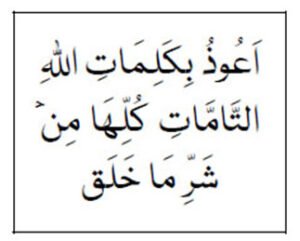
In such a Taweez, the blessed verse (Ayat-e-Mubaraka) can be clearly read, and its articulation points (Makharij) can also be verified by searching it within the Holy Quran. Such Taweezat are utilized for tying around the neck, binding onto the arm, and are also put to use for drinking (after being dissolved in water).
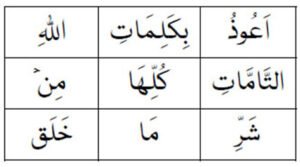
If this very same type of Taweez is formulated in the appearance of a Naqsh (numerical/geometric chart), its form would be as follows. This too shall be considered entirely permissible (Jaiz).
Nuqoosh Containing Numerical Values (A’dad)
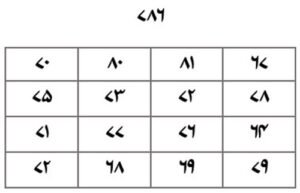
If a Naqsh is formulated based on the numerical values (A’dad) of a specific verse (Ayat) or Divine Names (Asma), strictly in accordance with the principles of Ilm-ul-Nuqoosh (the science of spiritual charts), its structural form would be as follows. In reality, numerical Nuqoosh are specifically structured and designed for non-Muslims, in instances where there is a strong probability or concern (Guman) that they might not be able to maintain the strict requirements of ritual purity and impurity (Paki/Na-paki), thereby ensuring that no desecration (Be-hurmati) of the sacred verses and Divine Names takes place. An example of a numerical Naqsh (Adadi Naqsh) is as follows:
Taweez and Naqsh Engraved on Metal
Those Taweezat or Nuqoosh that are engraved upon some metal, such as copper or silver, are referred to as a “Lawh” (plural: Alwah). While such Alwah are kept in one’s possession, they are generally not worn on the body. However, in the treatment of certain illnesses, they are explicitly dipped into water, and that water is given to the patient to drink; in such therapeutic cases, those Alwah are written upon paper using a specific spiritual ink. If there is a specialized Lawh that has been prepared based on a specific Divine Name (Ism), Verse (Ayat), Chapter (Surah), or Supplication (Dua), then the attribution of that Lawh will be directly linked to that specific Ism, Ayat, Surah, or Dua—such as Lawh Ayat-al-Kursi, Lawh Surah Al-Ikhlas, Lawh Nad-e-Aliؑ, and so forth. In this manner, any type of Lawh can be structured and formulated according to the underlying objective.
However, when it comes to the matter of Alwah-e-Sayyaregan (planetary tablets), the positions held by the practitioners (Amileen), the masters (Kamileen), and the people of spiritual path (Ahl-e-Tasawwuf) are all entirely distinct from one another. Alhamdulillah! All the Taweezat, A’maal, Nuqoosh, and Alwah that have reached us have been transmitted strictly from the courts of the Kamileen and the Ahl-e-Tasawwuf.
In the contemporary era, gentlemen and ladies also get such Taweezat and Nuqoosh engraved out of personal interest and keep them in their possession. Women often get a protective Taweez crafted inside a locket to keep with them. This is identical to how we purchase frames of Ayat-al-Kursi and the Char Qul Shareef from the market to hang upon the walls of our homes. Therefore, if purchasing such engraved and calligraphic frames from the market and hanging them in one’s home is Jaiz (permissible), then getting them crafted upon silver or copper and keeping them in one’s possession shall also be deemed entirely Jaiz—provided that those Alwah and Nuqoosh consist exclusively of specialized Quranic verses (Ayat) and Blessed Names (Asma-ul-Husna).
The Renowned Tabi’ee Sa’eed bin al-Musayyib, Ibn Sirin, and Taweez
Hazrat Sayyiduna Sa’eed bin al-Musayyib (رَضِیَ اللہُ عَنْہ) states: “There is no harm in hanging a Quranic Taweez after wrapping it inside a small case or a piece of paper.” Likewise, Imam Ibn Sirin (رَحْمَۃُ اللہِ عَلَیْہ) saw no objection or harm whatsoever in writing something from the Holy Quran and hanging it around a person’s neck. (Al-Bahr al-Muhit)
Recognizing Divine Permission (Izn-e-Ilahi) as a Conditional Pre-requisite for Efficacy
The Mujaddid (Reviver) of the tenth century, Hazrat Mullah Ali Qari ؒ (d. 1014 AH), writes regarding this Hadeeth: وَ هٰذَا أَصْلٌ فِي تَعْلِيقِ التَّعْوِیذَاتِ الَّتِي فِيهَا أَسْمَاءُ اللّٰهِ تَعَالٰی (Mirqat, Vol: 5, p: 236) Translation: “And this is a foundational principle regarding the suspension of Taweezat which contain the Names of Allah Ta’ala.”
From this, it becomes transparently clear that those Taweezat which consist of Divine Names (Asma-e-Ilahiyya) and blessed words (Kalimat-e-Mubaraka) possess an intrinsic spiritual efficacy within them, and treating patients through them is strictly categorized as Ilaj-bil-Quran (healing via the Quran).
However! Those Taweezat that consist of polytheistic words (Shirkiya Alfaz) are absolutely not permitted under any circumstances. In the narrations where Tama’im (amulets) and Ruqa (incantations) have been labeled as Shirk, the reference is strictly directed toward those specific types of Damm and Taweez wherein polytheistic words and rituals find active entry. The definite article “Alif-Lam” in the word “Al-Tama’im” is explicitly meant for this specific contextual categorization. Any Damm or Taweez that is entirely free from such polytheistic contamination is completely Jaiz (permissible) to utilize, and its spiritual efficacy is historically and structurally proven.
Muwakkilan, Jinnat, and Talasım within Taweezat
Any such Taweezat, Nuqoosh, or Alwah that contain the inclusion of any type of Muwakkil (spiritual guardian), Khuddam (servitors), or Talasm (talismanic cipher)—whether alongside Quranic verses (Ayat) and Divine Names (Asma) or entirely without them—is strictly impermissible (Na-jaiz) to wear. The general public must rigorously safeguard themselves and abstain from such Taweezat, Nuqoosh, and Alwah. All such objects do not offer deliverance from tribulations; rather, they become the core cause of compounding problems and severe spiritual backlashes (Raj’at).
Here, a critical clarification is necessary regarding the Taweezat, Nuqoosh, and Alwah provided by us: they fall strictly into two distinct categories:
-
Those that we formulate and prepare ourselves.
-
Those that people explicitly request us to craft for them.
The Taweezat, Nuqoosh, and Alwah that we prepare ourselves consist exclusively of Quranic verses (Ayat) and Blessed Names (Asma-ul-Husna). They are provided while strictly keeping the absolute requirements of the Shariah in view. There will be absolutely no sign, trace, or mention of any Muwakkil, Khuddam, A’wan (helpers), or Jinnat within them, because we are fully aware of their true spiritual realities.
Conversely, regarding the people who request us to engrave or craft a specific Naqsh or Lawh recommended to them by someone else according to their personal preference and desire—we execute such engraving only after undergoing a complete, rigorous investigation, screening, and scrutiny of the provided diagram. If it fails to meet our strict standards, we respectfully decline and offer our apologies (Ma’zarat).